In the world of paid ads, there is a fundamental divide that most founders and many traditional agencies completely ignore: the difference between Search Intent and Social Interruption. If you don’t understand this psychological split, you will keep running the exact same playbook across every platform, watching your runway disappear, and blaming the algorithm when the real issue is your overarching approach.
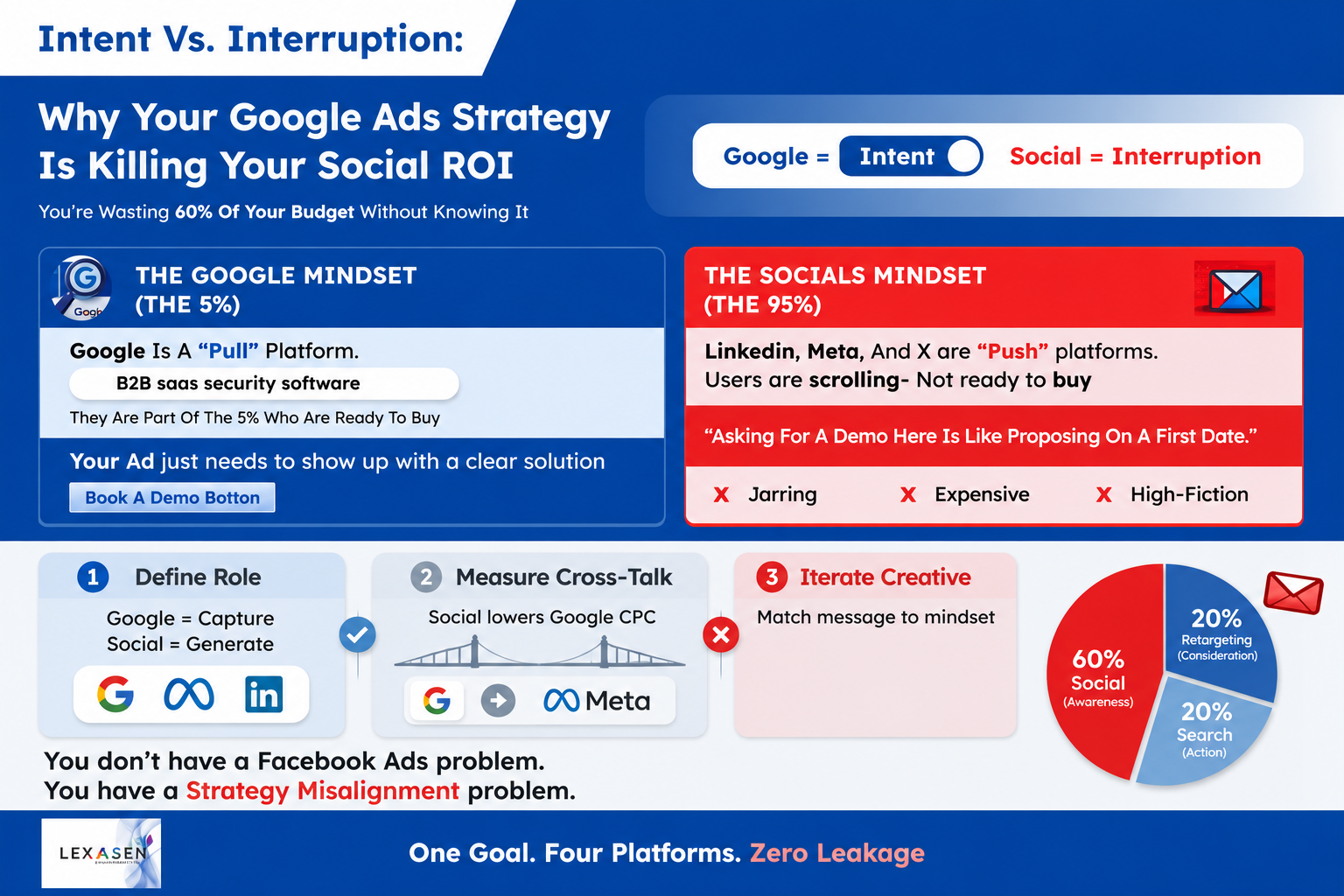
If you treat LinkedIn or Meta like you treat Google, you are essentially throwing 60% of your media spend into a black hole. The user on the other end of that ad is in a completely different state of mind—and state of mind is absolutely everything in paid advertising.
To scale predictably, you must move away from siloed channel management and deploy a deeply integrated paid ads strategy.
The State of Mind Split: Understanding Pull Intent vs. Social Interruption
The Google Mindset: Speaking Directly to the 5% In-Market
Google is a Pull platform. When a decision-maker types a specific phrase like “B2B SaaS security software” into a search bar, they are explicitly telling you they have an active pain point and are hunting for a solution right now.
That is pure intent—the most valuable signal in paid media because it completely removes the friction of top-of-funnel awareness. The buyer already knows they need a tool. Your ad simply needs to present a clear solution and a direct path to action (e.g., a direct pricing page, a free trial, or an immediate demo button). This is why Google converts exceptionally well for direct-response: the 5% are already in motion, and you are simply there to catch them.
The Social Mindset: Educating the 95% Before the Pitch
On the other hand, LinkedIn, Meta, and X are Push platforms. Nobody opens a social app to find their next enterprise software vendor or scrolls their feed looking for an intrusive SaaS demo. They are there to network, catch up on industry trends, or consume content.
When you interrupt that organic scroll with a hard-sell “Book a Demo” ad, you are making a massive sequencing mistake. It is the business equivalent of making a marriage proposal on a first date. The user has no idea who you are, no reason to trust your brand, and zero context for why your solution matters. The outcome is entirely predictable: high costs per click, near-zero conversion rates, and a growing frustration that “social ads just don’t work for our niche.”
The truth is they do work; your ask is just entirely wrong for where the buyer is sitting in their journey. The 95% of your market sitting on social platforms are not ready to buy today—they are ready to learn. They are open to having a problem named for them that they didn’t even realize they had. When you engage them with insights, data, and structural challenges to the way they currently operate, you do something Google search never can: you create high-intent buyers where none existed before.
The High Cost of Disconnected Channels: How Duplicated Playbooks Burn Runway
Why a Fragmented Approach Triggers the Wasted Budget Blues
When the exact same “Book a Demo” asset runs on Google and LinkedIn simultaneously, the channels actively cannibalize each other. Your social ads burn through capital by generating low-quality clicks from users who were never going to convert on the spot. Meanwhile, your search campaigns become less efficient over time because the top-of-funnel brand signals feeding them are entirely non-existent.
The platforms aren’t broken. The underlying architecture is. And that fragmented approach is exactly where the Wasted Budget Blues actually live.
How the DMI Framework Builds a High-Yield, Integrated Paid Ads Strategy
The ALL-IN-ONE DMI (Define, Measure, Iterate) framework is engineered around a core operational principle: every platform has a highly specific role to play, and those roles must be orchestrated as a single machine, never siloed and certainly never duplicated.
Here is how the DMI framework structures an integrated paid ads strategy to achieve true platform harmony:
Define: Synchronizing Demand Generation with Demand Capture
We define specific operational roles for each channel based on buyer psychology. Google handles Demand Capture—sweeping up the 5% who are already in-market and ready to take action. LinkedIn and Meta handle Demand Generation—educating, warming up, and systematically moving the 95% toward a buying decision over time. Defining these boundaries clearly ensures that every piece of creative copy, every budget allocation, and every call-to-action matches the user’s exact state of mind. No more premature marriage proposals.
Measure: Tracking the Invisible Cross-Talk Between Platforms
Most traditional agencies review each platform in complete isolation because Google, LinkedIn, and Meta all have separate, siloed reporting dashboards. They fail to measure the direct financial relationship between them. The DMI framework tracks the cross-talk: demonstrating how an educational video asset on LinkedIn systematically decreases the cost-per-click and increases the conversion rate on your Google Search ads weeks later. When your brand is deeply familiar, your high-intent search ads convert faster and significantly cheaper.
Iterate: Tailoring Creative to Match the Buyer’s Journey
We utilize Google’s ABCD Framework to ensure your social ads actively earn the interruption by leading with sharp attention, building core belief, creating a human connection, and directing action based on where the audience stands. Concurrently, your search ads are continually optimized to fulfill existing intent as efficiently as possible. Two completely different creative approaches, two completely different jobs—yet both engineered to feed the exact same pipeline.
The Verdict: Achieving Platform Harmony Through Structural Architecture
You do not have a Facebook, Meta, or LinkedIn Ads problem. You have a Strategy Misalignment problem, one that becomes glaringly obvious the moment you step back and look at your acquisition funnel as a holistic system.
When you match your core messaging to the user’s actual state of mind—intent on search, deep education on social, and sharp retargeting in between—the operational friction disappears. Your Customer Acquisition Cost (CAC) drops, and your ad channels stop competing for internal budget and start feeding each other. That is true platform harmony.
Ready to stop chasing channels, align your growth stack, and execute a mathematically sound, unified media engine?
👉 Download the Lexasens ALL-IN-ONE DMI Framework Blueprint Here