In most startup boardrooms, “Marketing” sits under Expenses. It is lumped right next to office rent and software subscriptions. And when times get tough, it is inevitably the first line item to get cut.
You see, when marketing feels like a sunk cost rather than a driver of growth, it’s because the strategy behind it was never built to compound. It was built to bill. If you want your business to scale predictably, you have to shift your perspective and learn to treat marketing as an investment. There is a massive, structural difference between an expense and an asset—one that shows up clearly on your P&L the moment you know what to look for.
If your paid media campaigns aren’t building a compounding asset, you are simply burning cash. And that’s exactly how startups exhaust their runways without ever understanding why growth didn’t follow.
How Generic Agencies Turn Your Ad Budget Into a Leaking Bucket
The Three Hidden Flaws Draining Your Capital
Look, most traditional agencies are optimized for vanity metrics, more impressions, more clicks, more reach. These are the metrics they report because they are easy to show and easy to use to justify the next monthly invoice.
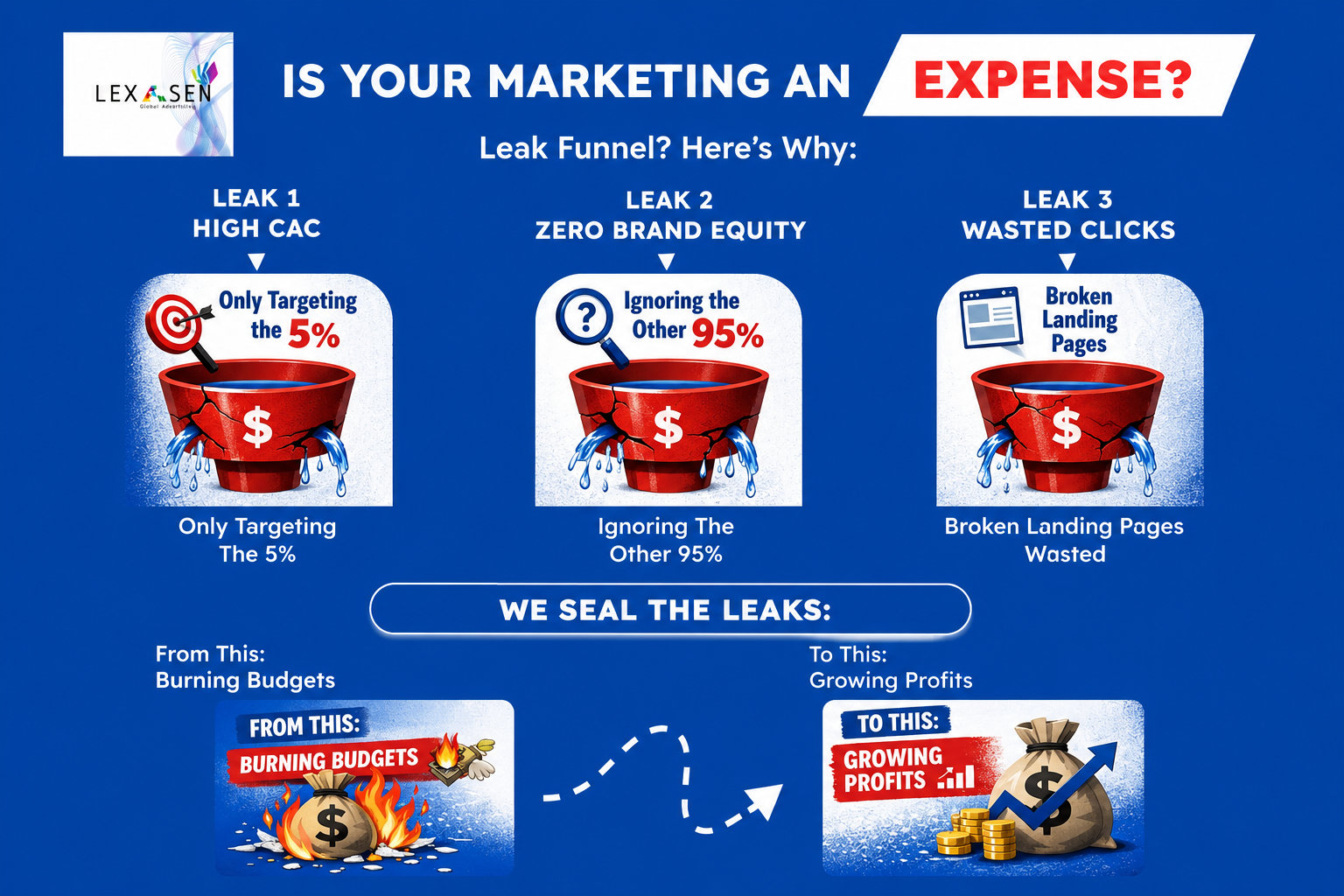
But focusing strictly on vanity metrics is like pouring water into a leaking bucket. The numbers look active, and the spend goes out. Underneath, however, your capital drains through structural gaps nobody bothered to fix.
Here are the three most common leaks draining startup budgets:
The Cold Start Gap: Generic agencies send completely cold traffic directly to a high-friction “Book a Demo” page. These are people who have never heard of your brand, have no reason to trust you, and are nowhere near ready to make a buying decision.
When 95% of them bounce and never return, that’s not a conversion problem, it’s a sequencing problem that costs you the majority of every dollar spent acquiring that traffic.
The Attribution Blindspot: Without a unified framework, agencies cannot tell you how your LinkedIn awareness ad influenced your Google search conversion three weeks later. Because they optimize each channel in isolation, they miss the compounding effect entirely. You end up cutting the critical brand spend that was quietly making your performance spend work, simply because nobody could prove the data connection.
The Creative Stagnation: Running the exact same static image, headline, and call to action (CTA) for 60 days straight triggers heavy audience ad fatigue. As performance drops, the spend continues. Traditional agencies will just report on the impressions, completely ignoring whether anyone is actually paying attention anymore.
Each of these leaks is individually damaging. Together, they can drain an entire quarter’s runway without producing a single compounding result.
The DMI Sealant: Frameworks Designed to Treat Marketing as an Investment
The ALL-IN-ONE DMI (Define, Measure, Iterate) framework was built specifically to seal these operational leaks and turn marketing from a monthly cost center into a growth engine that gets more efficient over time.
Here is how each phase of the DMI framework addresses capital leakage directly:
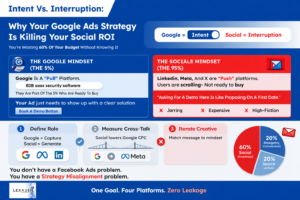
Define: Building Structure Across the 95/5 Split
We don’t just target a loose demographic; we define the exact path the buyer travels—from the 95% who are completely unaware of your brand, all the way through to the 5% who are ready to buy. Every piece of creative, every touchpoint, and every budget decision is mapped to a specific stage of that journey.
No cold traffic hits a demo page on their first interaction, ensuring no budget is wasted on audiences that haven’t been systematically warmed up first.
Measure: Tracking how Brand Spend Makes Acquisition Cheaper
We use the 20-20-60 Rule to track the flow of your budget in real time across the entire funnel. The key metric isn’t just how many instant leads the conversion campaigns are producing; it’s whether the 60% invested in top-of-funnel awareness is actively lowering the Customer Acquisition Cost (CAC) on your 20% conversion spend.
That relationship is the engineering signal that tells us whether the framework is compounding or if an allocation adjustment is needed.
Iterate: Turning Real Data into a Zero-Leakage Pipeline
We use data-driven conversion rate optimization to fix the drop-off points where future buyers are leaving the funnel. Landing pages, ad sequencing, creative rotation, and audience exclusions are tested and refined based strictly on backend numbers, not what looks pretty in a slide deck. Creative assets get refreshed before the audience gets fatigued, and angles get proven before budgets are scaled.
The result is a funnel that compounds. Each phase feeds the next, meaning every dollar spent building brand equity structurally makes your next dollar spent on demand capture cheaper to convert.
The Financial Shift: The Mathematical Difference Between a Cost and an Asset
Why Winners Transition from Expense Thinking to Marketing as an Investment
In a growth context, an expense is something you pay simply to stay in business. Treating marketing as an investment, however, means fueling a system designed to grow it. The difference isn’t the dollar amount on the invoice; it’s whether the spend is building an asset that makes future spend more efficient.
Brand equity is an asset.
First-party audience data is an asset.
A warm, high-intent retargeting pool is an asset.
A creative library built on validated performance signals is an asset.
When your agency is building these infrastructure pieces systematically, your marketing is a true investment. When they are merely reporting on clicks and asking for a higher ad spend next month to fix a flatlining campaign, it is a line-item expense, and an increasingly frustrating one.
The founders who make the shift from expense thinking to asset investment are the ones who stop panicking and cutting budgets when growth slows. Instead, they start asking deeper, harder questions about where the leaks are in their funnel architecture.
The Verdict: Stop Funding a Leaky Funnel and Build a Compounding Growth Engine
If your ad account doesn’t feel like a high-yield asset, your underlying framework is leaking. The fix isn’t pouring more budget into a broken bucket; it’s deploying a better system designed to ensure every dollar spent builds leverage for the next.
The DMI framework is engineered to seal those operational leaks, compound your data assets, and turn your marketing line item from a cost center into the most productive engine in your growth stack.