For most tech founders, the advertising dashboard is a source of pure anxiety. The spend climbs yet growth crawls. You’re told to scale, so you increase the budget, but your acquisition metrics rise right alongside it, leaving you trapped with more money going in and the same slow trickle coming out. If you are struggling to lower customer acquisition cost while expanding your market reach, you have walked straight into the Startup Growth Trap.
It’s not an execution failure or a bad creative issue; it’s a structural math problem. And once you understand how your budget is actually being distributed across your market, you’ll never look at your ad accounts the same way again.
The 95/5 Reality: Understanding Where Your Market Actually Lives
Every market, regardless of industry, operates on a predictable split at any given moment:
- 5% of your market is In-Market. They have the problem, the budget, and they are actively searching for a solution right now.
- 95% of your market is Out-of-Market. They are your future buyers, unaware of the problem, not yet ready to switch providers, or simply not in the decision window yet.
This is not a theory. It’s a well-documented principle in B2B marketing research, and it fundamentally changes how a smart growth strategy should be built.
The 5% are ready today. The 95% are ready eventually. The goal is to own both pipelines, not just one.
Why Focusing Only on the 5% Makes It Impossible to Lower Customer Acquisition Cost
If your entire paid ads strategy is built exclusively around immediate, short-term responses (“Book a Demo,” “Buy Now,” or “Start Your Free Trial”) then you are fighting a bloody, expensive war for that tiny 5% sliver of the market.
When you bottleneck your strategy this way, you trigger a chain reaction that actively works against your margins:
Every single competitor you have is bidding on those exact same people.
Platform auction prices rise as more brands fight for the same limited pool.
Your ad account fatigue increases, making your metrics climb even as your budget grows.
You win some deals, but at a heavily shrinking profit margin.
This is what’s known as a Red Ocean: a market so saturated with competition that only the biggest budgets survive. Startups almost never win Red Ocean wars because they get outspent and pushed out.
Here’s the part that stings even more: while you’re fighting for the 5%, the 95% which is your actual future revenue sits completely ignored. You’re not building any relationship with them nor are you on their radar. So when they finally become ready to buy, they don’t think of you. You have to ‘rent’ their attention all over again at premium prices, competing from zero brand recognition all over again.
The point: Every dollar you spend ignoring the 95% is a dollar working against your to lower customer acquisition cost over time.
Nurturing the Future Majority: How Demand Generation Creates Sustainable Margins
The brands that scale efficiently don’t just harvest existing demand, they systematically create it. They show up for the 95% before those buyers are even in-market, so that by the time those buyers are ready to make a decision, your solution feels like the obvious choice.
This is called demand generation, and it’s the difference between brands that grow predictably and brands that remain stuck on the ad-spend treadmill.
Demand generation means:
- Educational content that addresses pain points the buyer doesn’t yet have a name for.
- Brand storytelling that builds familiarity and trust over time.
- Strategic retargeting that keeps you visible through the buyer’s journey, not just at the end of it.
When the 95% eventually shifts into the buying window, they already know who you are. The sale becomes easier. The CAC drops. The lifetime value per customer climbs.
The Escape: Use the ALL-IN-ONE DMI Framework to Lower Customer Acquisition Cost
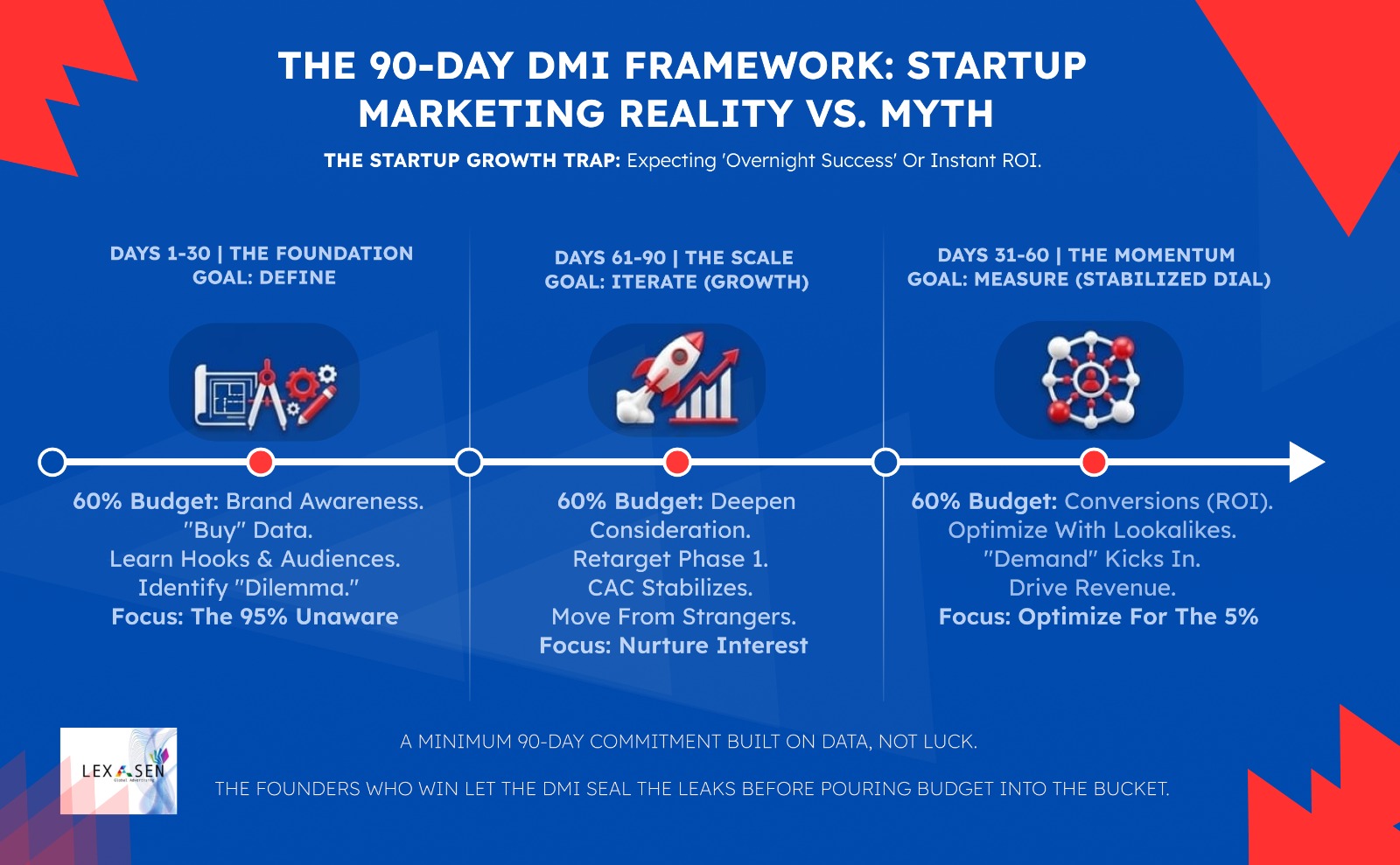
At Lexasens, this is the exact gap we solve. We built the DMI (Define, Measure, Iterate) framework specifically to bridge the 5/95 divide here that way brands aren’t just harvesting the ready buyers, they’re actively engineering the pipeline of future ones.
Here is how the DMI framework runs in practice to protect your margins:
Define
We map your audience into two clear segments: who is ready now, and who will be ready later. Both segments get tailored messaging and engineering-backed positioning, rather than a lazy, one-size-fits-all “Book a Demo” CTA.
Measure
We track the direct harmony between your brand-building activity and your performance campaigns. We analyze exactly how your awareness spend is making your conversion spend more efficient, giving you the real data needed to lower customer acquisition cost.
Iterate
We let data, not bias, decide. No more “this ad creative feels right.” We make systematic adjustments and optimizations based strictly on what the backend numbers say.
The 20-20-60 Budget Model: Engineering a Compounding Growth Engine
Built directly into our DMI framework is the 20-20-60 Rule, a budget allocation model designed to ensure your spend is doing real work across your entire market:
20% Action: Captures the 5% who are ready to buy right now.
20% Influence: Re-engages warm audiences who have already interacted with your brand assets.
60% Awareness: Educates and nurtures the 95% that represents your future revenue engine.
The result isn’t just a brief spike in short-term conversions. It is a compounding growth engine that gets more efficient over time, keeping your overhead low while your baseline scales.
The Bottom Line: Stop Chasing Immediate Clicks and Start Building Infrastructure
If you only talk to the people ready to buy today, your brand will remain invisible by the time the rest of the market catches up. You will keep paying premium auction prices for the same shrinking pool of buyers, wondering why scaling your budget doesn’t scale your results.
The Startup Growth Trap isn’t about bad ad accounts. It’s about a strategy that was never structurally designed to win the long game.
The fix isn’t pouring more money into a leaky bucket; it’s smart, intentional allocation across your entire market, not just the loudest corner of it.