In the world of startup growth, there is a constant, exhausting tug-of-war. On one side, you have the Brand Purists. They want beautiful videos, compelling storytelling, and long-term awareness. They tell you to be patient. But as a founder watching your burn rate climb, patience feels less like wisdom and more like a luxury you simply cannot afford.
On the other side, you have the Performance Junkies. They want clicks, leads, and ROAS today. They pump every dollar into direct-response ads. But eventually, the leads dry up. The audience hits ad fatigue. Costs skyrocket. And you’re back to square one, just with a lighter bank account.
Here’s what nobody tells you: both sides are right, and both sides are wrong. The real problem isn’t which discipline you choose; it’s the fact that you’re being forced to choose in the first place. Scaling past your next milestone without burning through your runway requires a shift away from siloed tactics toward a single, integrated paid ads strategy, one where trust and conversion operate as a continuous feedback loop.
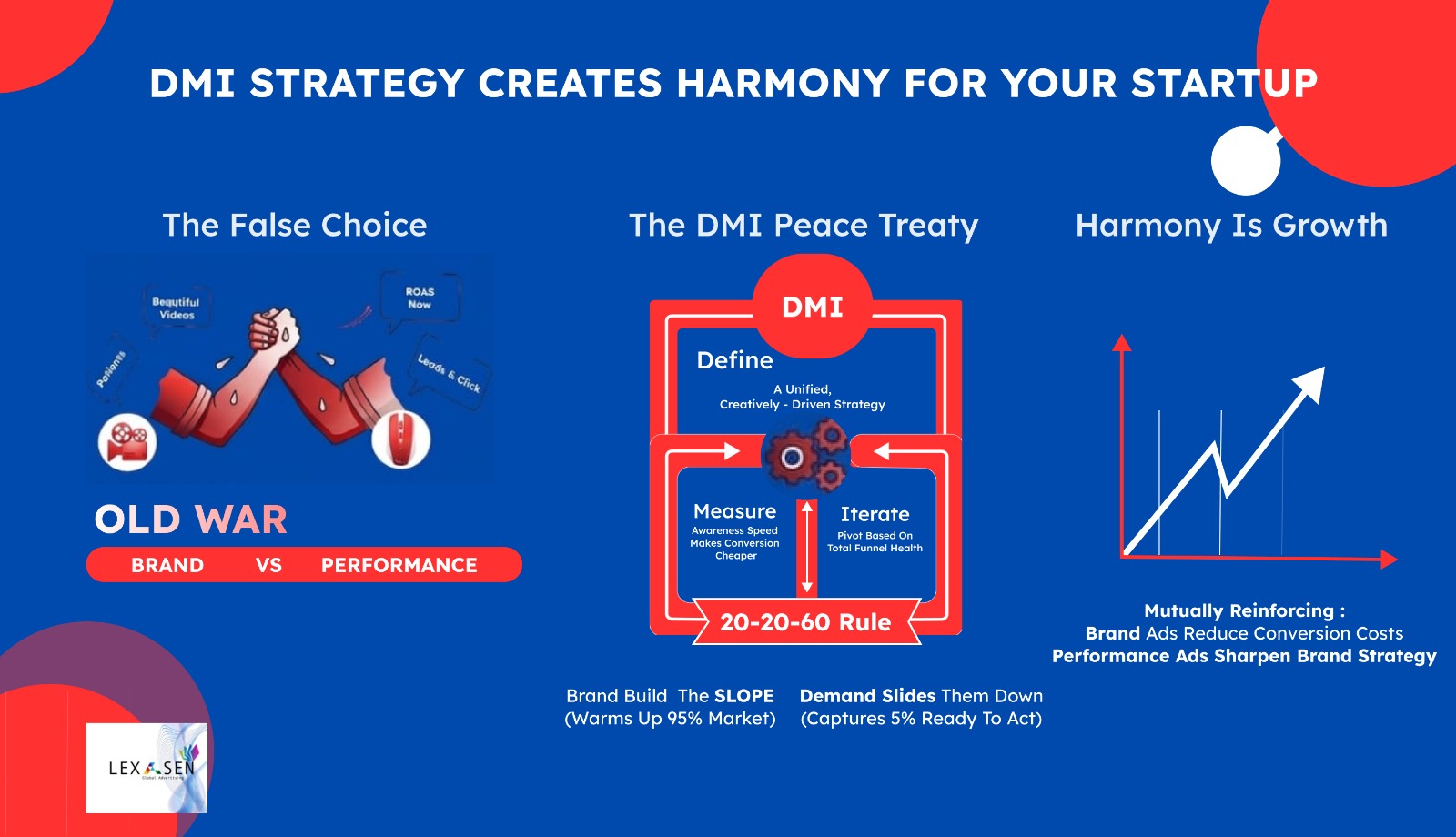
The False Choice Killing Your Growth: Brand vs. Performance
Most agencies treat Brand and Demand as separate departments with separate budgets, separate KPIs, and separate agendas. Brand wants to tell a story. Performance wants to hit a target. And in the middle, your marketing becomes disjointed, getting pulled in two directions while your budget quietly bleeds out.
Here’s what that looks like in practice:
- Your awareness ads build interest, but don’t lead anywhere actionable.
- Your conversion ads are talking to cold audiences who have never heard of you and don’t yet trust you.
- Your CAC climbs because paid acquisition is doing all the heavy lifting with no brand foundation underneath it.
- Your retargeting underperforms because the content people saw wasn’t compelling enough to leave an impression.
This is the brand vs. performance war. And the only ones winning it are your competitors who figured out how to stop fighting it.
Why an Integrated Paid Ads Strategy is the Only Scalable Answer
The brands that scale efficiently, the ones that hit predictable ROAS without blowing their customer acquisition budget are not choosing between brand and demand. They are running them as a single, integrated paid ads strategy.
Think of it this way: Brand marketing builds the slope. It warms up the market, creates familiarity, and earns trust with the 95% of buyers who aren’t ready to purchase yet. Demand marketing slides buyers down that slope, capturing the 5% who are in-market right now and converting them efficiently because the brand has already done the groundwork.
When these two forces work together, something powerful happens:
Cheaper Conversions: Brand ads make conversion ads cheaper because you’re no longer paying to convince total strangers after all, they already know you.
Smarter Optimization: Conversion ads make brand ads smarter because the performance data tells you which messages actually resonate and which ones fall flat.
Compounding Equity: CAC drops over time instead of climbing because you’re building brand equity with the market, not just renting attention minute-by-minute.
Higher Retention: Customer loyalty increases because buyers who came in through a brand-first journey are far more likely to stick around.
This is what a sustainable, integrated paid ads strategy actually looks like. It is not a battle; it is a high-performance feedback loop.
The DMI Peace Treaty: Engineering Your Integrated Paid Ads Strategy
At Lexasens, we built the ALL-IN-ONE DMI (Define, Measure, Iterate) framework specifically to end this false war and replace it with harmony: a unified methodology where brand and demand work as one.
Here is how the DMI framework structures your integrated paid ads strategy:
Define
We map out exactly how Brand and Demand will support each other as a single, coordinated strategy with shared goals. Every creative decision and every budget allocation is made with both functions in mind.
Measure
We don’t just track clicks and leads in isolation. We measure how your awareness spend is actively making your conversion spend more efficient. If your brand marketing is working, your downstream conversion costs should be dropping. That relationship is the real KPI.
Iterate
We adjust based on the total health of the funnel, not just what a single performance dashboard says this week. Emotion out. Data in. We look at brand lift, audience warm-up rates, and downstream conversion quality together.
The 20-20-60 Rule: Putting Mathematical Structure Around Integration
Built into DMI is our core budget framework that puts real structure around an integrated paid ads strategy:
20% Action: Captures the 5% who are ready to buy right now through direct-response campaigns.
20% Influence: Re-engages warm audiences who have already interacted with your brand.
60% Awareness: Educates and nurtures the 95% who will become buyers later—building the brand equity that makes all future acquisition cheaper.
-
Creatively Driven. Data Backed. Always Integrated.
The best-performing paid ads strategies are not just clever creatives or sharp targeting. They are creatively driven on the brand side and data-backed on the demand side, and those two disciplines are in constant conversation with each other.
Creative decisions inform targeting. Targeting data informs creative. Brand metrics influence demand budgets. Demand results validate brand positioning.
This is not a luxury approach for companies with unlimited budgets. It is the scientific requirement for any startup that wants to grow without burning through cash doing it.
When your brand and demand marketing operate in silos, you are essentially running two half-strategies. When they operate in Harmony, you have a complete strategy.
The Verdict: Stop Renting Attention and Build a Unified Growth Engine
Stop choosing between brand and performance. That choice was always a false one, invented by agencies that benefit from splitting your budget across two separate retainers.
An integrated paid ads strategy is not a nice-to-have luxury for companies with unlimited budgets. It is a scientific, data-backed requirement for any startup that wants to grow without burning through cash doing it. Every dollar you spend on brand should make your performance spend more efficient. Every lead your performance ads generate should reinforce the brand story you’re building.
That is Harmony. And it is the only way to build a paid ads engine that gets stronger over time, not more expensive.