In the age of “Growth Hacking” and “Instant ROI” screenshots, tech founders have been sold a dangerous lie: that a great advertising campaign should work instantly. It wasn’t supposed to. Believing that a high-performance paid ads strategy can be built, optimized, and scaled in a single week is one of the most expensive mistakes a founder can make.
If you deploy your marketing budget expecting a winning campaign in just 7 days, you are setting yourself up for the Startup Growth Trap. You’ll panic, pivot too early, kill the very momentum you were trying to build, and then wonder why nothing ever seems to stick.
The problem isn’t your product, and it isn’t even your creatives. It’s the unrealistic timeline you’re holding your strategy to.
The “Overnight Success” Trap and Where Your Marketing Timeline Goes Wrong
The growth hacking era did something incredibly damaging to how founders view business development. It created a culture of highlight reels, viral launches, 10x ROAS screenshots, and case studies that conveniently skip the 60 days of groundwork that made those results possible.
The truth is that every overnight success story has a 90-day backstory nobody talks about. The brands that appear to “blow up” did so because they spent weeks building audiences, testing hooks, warming up cold traffic, and letting their data mature before they ever optimized for conversion.
They weren’t lucky; they were patient. And patience, when executing a modern paid ads strategy, is a competitive advantage most founders are simply too anxious to claim.
The 90-Day Science: Structuring a Sustainable Paid Ads Strategy
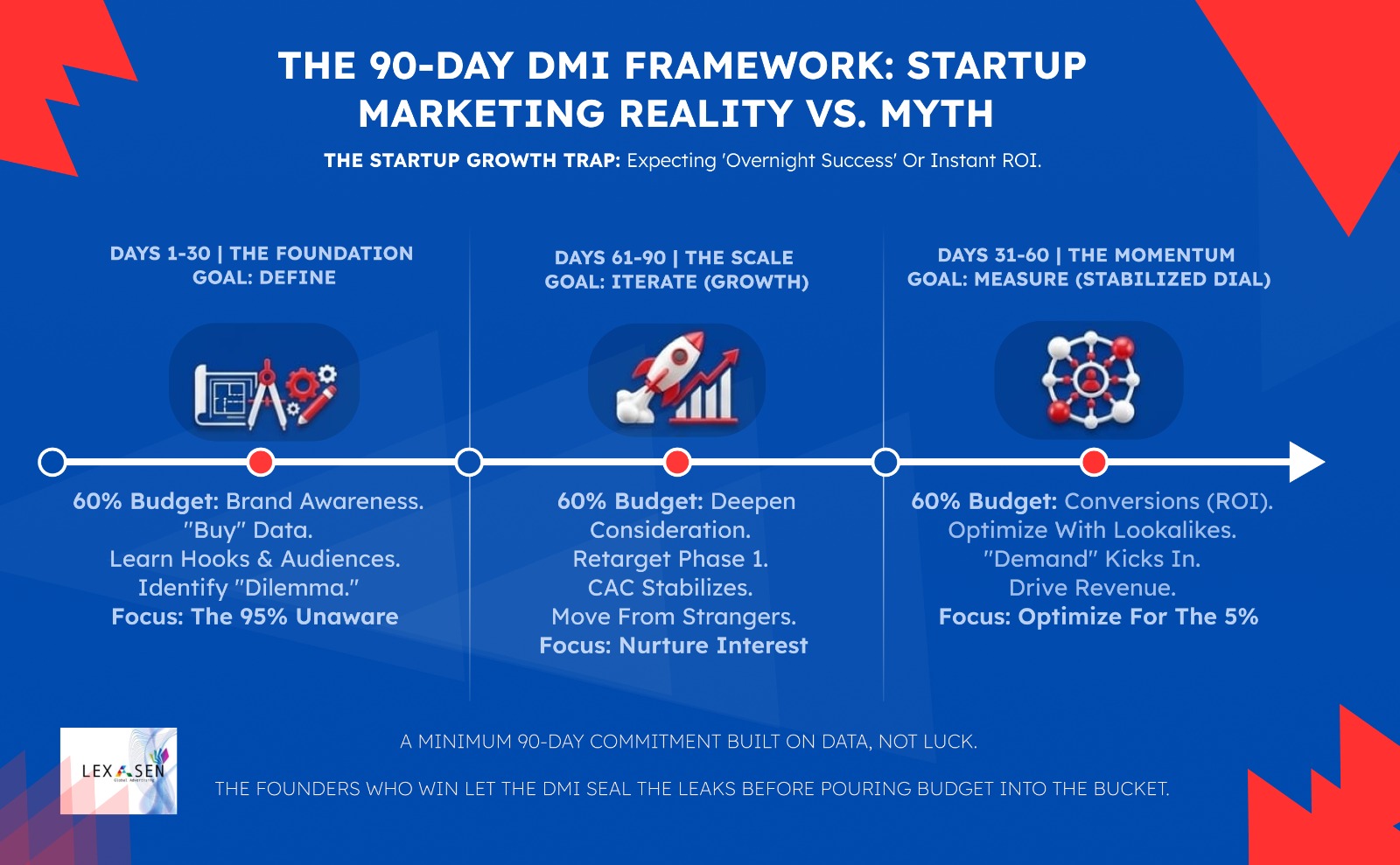
At Lexasens, we recommend a minimum 90-day engagement. Not because we want a longer contract but because the ALL-IN-ONE DMI (Define, Measure, Iterate) framework is built on data, and data takes time to become reliable.
Here is what the 90-day reality actually looks like, phase by phase, when building a high-performing paid ads strategy:
Days 1–30 — The Foundation: Buying Data, Not Clicks
We are defining the market. In this phase, 60% of the budget goes toward Brand Awareness under our 20-20-60 rule. This is where we buy data. We learn which hooks stop the scroll, which creative formats hold attention, and which audience segments actually care about the problem your product solves.
No conversions yet. Just signals, and those signals are worth more than any premature, low-intent lead.
Days 31–60 — The Momentum: Measuring Intent and Stabilizing CAC
At this stage, we measure the response. The 60% focus shifts to deepening consideration. We retarget the people who engaged in Phase 1, that’s people who already know who you are. Your CAC begins to stabilize because you are no longer talking to strangers. You are talking to a warm audience that has seen your brand, recognizes your message, and is moving down the slope toward a decision.
Days 61–90 — The Scale: Iterating for True ROI
We are iterating for ROI. This is where demand capture kicks in fully. We optimize the 60% for conversions using the custom and lookalike data segments built over the first 60 days. By this point, your creative is proven, your targeting is refined, and your funnel leaks have been completely sealed. The result is a conversion engine running on real data, not hope.
Why Pulling the Plug Early Is the Most Expensive Mistake in Your Paid Ads Strategy
Here is what happens when a founder panics at Day 21 and kills the campaign: they lose absolutely everything they paid for in Phase 1. The audience data, the creative learnings, and the brand familiarity they were starting to build with the 95% of the market are wiped clean.
They restart from zero, often with a different agency, a different angle, and the exact same impatience. The cycle repeats, CAC stays unsustainably high, and top-line growth remains flat.
This pattern is not a tactical flaw; it’s a restraint problem. It’s far more common than most traditional ad agencies will admit, because broken agencies benefit every time a founder restarts the clock and buys a new setup fee.
The winners understand that the first 30 days of a new paid ads strategy are not supposed to produce immediate sales; they are supposed to produce the data architecture that makes subsequent sales predictable. That data is the asset, and it compounds.
Real Growth is an Investment, Not a Bet
You wouldn’t judge a seed-funded product based on its first week of code nor would you fire your engineering team because the MVP wasn’t perfect on Day 7 or would you? Growth works the same way.
A paid ads strategy is a growth engine. Engines don’t run at full capacity the moment you turn them on. They warm up, get fine tuned and become more efficient over time, but only if you give them time to run.
The 20-20-60 Rule inside DMI is designed to work across a full 90-day arc. The 60% brand investment in Month 1 is what makes the 60% demand capture in Month 3 so efficient. Skip the foundation, and the whole structure collapses.
The Verdict: Stop Gambling and Let Your Growth Engine Compound
Sustainable startup growth doesn’t happen in a vacuum. It happens through consistent iteration and the discipline to let your data mature before you demand results from it.
The founders who win are the ones with the restraint to let the DMI framework seal the leaks before they try to pour more budget into the bucket. The ones who lose are the ones still chasing the overnight myth, restarting campaigns every three weeks and wondering why nothing ever scales.
90 days isn’t a long time. It’s the minimum. And it’s the difference between a campaign that collapses and a growth engine that compounds.